Saturday, December 9, 2023

Indian Puerto Rico Under Bondage


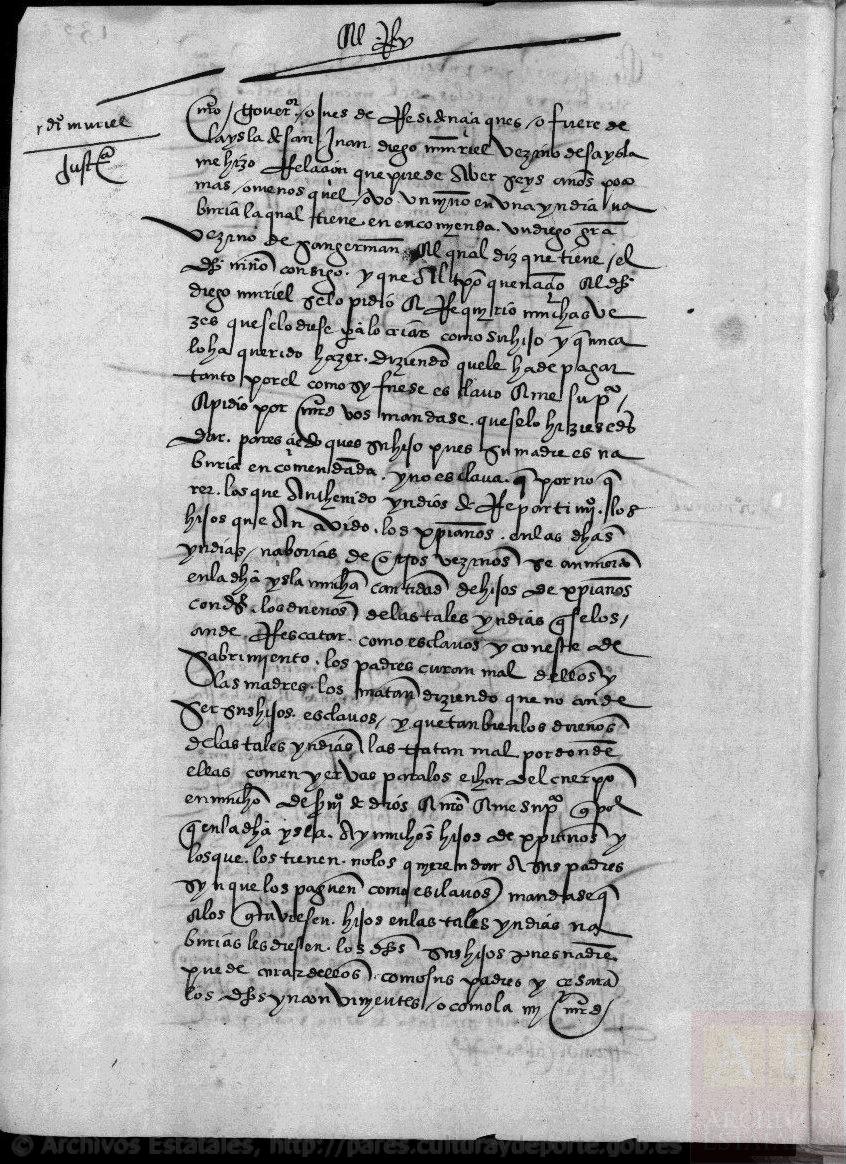
Another mention of Diego Muriel digitized at PARES contains some very interesting information on the Indian laborers of  the royal Hacienda of Ribera de Toa in 1528. Established with indigenous Puerto Rico caciques and Indian laborers, the document provides some powerful testimony about the exploitative conditions in which Indians in the encomienda system toiled under. Reading between the lines, one can surmise that the "Taino" of Puerto Rico, at least in this hacienda, were scarcely acculturated into Spanish ways. The document lists the improved treatments to be given to the Indians, including ensuring their indoctrination in the Catholic faith and having access to Mass twice per week. One can probably conclude that before 1528, and perhaps after this year, they were not devout or deeply Catholic. In addition, the stipulation that Muriel see to it that the Indians understand marriage and cease the practice of males shifting to different women suggests the indigenous laborers were not following Spanish or Catholic norms of marriage and domestic organization. 

The other proposed methods to improve the treatment of the Indian workforce included the provision of meat, hammocks or blankets, and additional clothes. Perhaps the population was still wearing Indian-styled clothing of enaguas and whatever they received for use during worktime. Overall, this suggests an indigenous population that was probably maintaining older, precolonial practices in religion, spirituality, diet, and dress to whatever extent that was still possible in 1528. As Guitar revealed in her dissertation on Tainos of Hispaniola, the indigenous population in Puerto Rico was probably still practing their areytos, cohoba rituals, and the ballgame, too. Unfortunately for us, however, no one recorded more of the traditions, areytos, or customs of the Puerto Rican Indian that may have given us far more information on precolonial, pre-Hispanic history. But the thin or superficial conversion and Hispanization of the indigenous population definitely explains why their legacy is so strong in Puerto Rico and the Spanish Caribbean. 

Tuesday, December 5, 2023

Diego Muriel's Mestizo Son


The story of Diego Muriel is a disturbing one. Before marrying the cacica of Caguas, he fought for the rights to his mestizo son. The issue was the mother was a naboria india, held in an encomienda by Diego Garcia in San German. Diego Garcia only wanted to give Diego Muriel his son for a price, selling him like a slave. Diego Muriel took the case higher up in government to resolve it, and we sadly do not know the results. However, the fact that this occurred to begin with is suggestive of the few distinctions between naboria and enslaved Indians at this time (1528). Similar scenarios probably occurred elsewhere in the Spanish Antilles of this era, as white men sometimes had relationships with women they did not control. What is even more interesting is that this 1528 document seems to suggest that children in similar situations were often abused by the encomienda owners. 

Sunday, December 3, 2023

Benzoni and the New World

Girolamo Benzoni's The History of the New World is a fascinating snapshot of various regions of the Spanish colonial empire in the mid-16th century. Despite his overwhelming anti-Spanish bias and lack of style, Benzoni visited the Antilles, Venezuela, Colombia, Panama, Peru, Guatemala and parts of Central America. While much of the regions he visited were depopulated (like Hispaniola) or areas of recent conflict or abandonment, due to the violent greed of the Spanish), Benzoni's perspective is fascinating. For instance, his description of Taino customs of Hispaniola and Indians of Venezuela are, despite occasionally being derivative of early Spanish customs. His description of Indian customs in Hispaniola, for instance, suggests these practices were very much alive, despite the demographic collapse of the indigenous peoples. Benzoni's presence in Hispaniola also provides some descriptions of the real fear the Spanish felt with the large African maroon population on the island. Similarly, the attacks by African runaways in Panama against the Spanish indicates just how fragile this colonial empire was. Indigenous people did not sit idly by and kindly agree to give away all their land, resources and labor. Nor were enslaved Africans eagerly serving their white masters. The state of insecurity, depopulation (partly fueled by Indians abandoning settlements to avoid whites), and conflicts among the Spanish themselves are clearly illustrated by Benzoni's experiences. One only wishes Benzoni provided a little more detail about parts of his travels, such as the caravel carrying Indian slaves from South America to Puerto Rico and Hispaniola.

Saturday, December 2, 2023

Juan de Humacao


Although finding the details of Juan de Humacao's life remains difficult, it is interesting to read about a literate cacique of Puerto Rico. Freed in 1526 after being enslaved by Juan de Ceron, Juan de Humacao, perhaps a nephew of the Humacao chief who fought with the Spanish in the 1510s, was recognized as a free man. It is interesting to see that even as late as 1526, when the indigenous Taino elite were presumably of less importance due to the population decline of Indians, the Spanish royal government felt compelled to ensure a local cacique was freed from bondage. Unfortunately, it is unclear what happened to this literate cacique after November 1526. According to Francisco Moscoso, the first Humacao in the Spanish sources was a victim of Spanish raids in 1512. Then, he, along with Daguao, another cacique, were at war with the Spanish in 1515. Later, presumably due to the death or disappearance of the original Humacao, a cacica, Isabel Cayagua, and her naborias, were given to the encomienda of Antonio Sedeno. So, presumably some time after 1515, Humacao perished or perhaps fled the island while Isabel Cayagua became the recognized cacica of Humacao. It would be fascinating if someone could uncover archival sources that include letters or writings by Juan de Humacao. 

Wednesday, November 29, 2023

The Taino Woman

Although possibly dated in some respects, Jalil Sued Badillo's La mujer indígena y su sociedad is a very valuable read for anyone interested in the Taino. The author does an excellent job outlining the basic known factors in that complex mosaic of Tainoness found in the Antilles. Explaining the rise of cacicazgos, the greater development of stratification in said societies, and the importance of Puerto Rico and Hispaniola in this process, the author then examines what is known about indigenous women for various topics. It becomes clear that women were vital players in most aspects of society, particularly in the wielding of power and providing the labor for much of the subsistence, arts, crafts, and sociocultural activities of the Taino. Consequently, the Spanish conquerors quickly realized this, so the colonial order established by Europeans was very much a gendered one.

For instance, in religion and myth, women are, unsurprisingly, central. Perhaps as a product of the common pattern in ancient farming communities, women were associated with the land, fertility and the moon, all important associations in the Taino cosmovision and daily life. This significance is reflected in what is known of Taino religion from the Spanish sources. For instance, Guabancex,and her role in storms known as hurricanes. Or the mother of Yucahu, who had 5 names. Indeed, having so many names was, to the Taino, a sign of power. Some of the mythological figures we know of, like Guahayona, were a source of power. As illustrated by Guabonito, through whose aid Guahayona receives guanin and symbols of cacical authority (acquired through matrilineal succession patterns). All of these religious and mythological associations are connected to the associations of femininity with fertility, the moon, land, and, through myth, as the source of power. In addition, women also serves as shamans or behiques, according to at least one source from early colonial Hispaniola.

The Taino woman also played necessary and essential roles in agriculture, labor, artisanry and production. Women's labor was key in agriculture, preparing casabe, and producing a number of utilitarian tools and objects for daily life. Women similarly were artisans, involved with producing cotton textiles or objects associated with trade and ceremony. An example not cited by Sued Badillo can be seen in the role of women in La Gonave as producers of fine wooden objects. Women may have even been involved in gold mining, something we do not know enough about yet. Thus, women's labor was essential for subsistence, ceremony, arts and for items of exchange between communities. For these reasons, control of women's labor must have been one of the factors contributing to conflicts between communities or caciques. 

From what can be deduced on Taino family structure and the life cycle of women, it appears that women may have went through initiations upon puberty and possibly followed marriage customs similar to those observed in the Lesser Antilles and South America. We know from the Spanish chroniclers that girls began to wear a short skirt upon reaching puberty. Then, once they married, women wore longer skirts, especially those from the Taino elite. There were likely rituals or initiations attached to puberty and marriage. Divorce, on the other hand, may have been a simpler affair. In terms of sexuality, it seems likely that women before marriage were allowed to have sexual partners. Women as wives were additionally important for establishing alliances and kinship between different cacicazgos. As suggested by Sued Badillo, perhaps Agueybana's relations with Andres de Higuey were based on a marriage of relatives. However, unlike male caciques or nitainos, we have no evidence of female rulers having multiple husbands. Likewise, one wonders if husbands or males were ever buried with a deceased cacica to accompany them. Sued Badillo speculates that such a practice may have been a late development in the precolonial Caribbean for wives of caciques to be buried with them.

Besides in the areas of religion, economy, and arts, the Taino woman was similarly important in other areas of life. Women were participants in the batey games. They were also participants in areytos, with the famous report of 300 maidens involved in one for Anacaona of Jaragua. This reveals that women were not excluded from major community events that were of a public, communal nature and tied to the history and cosmovision of the Taino. Moreover, women could exercise authority themselves as cacicas. These female rulers likely enjoyed all or most of the prerogatives that their male counterparts possessed. So, not only was access to the position of cacique usually through the female line (patrilineal descent may have been in the process of spreading), but women could emerge as leaders in their own right. Even mothers of caciques exercised a political influence, as Agueybana's mother had been a major voice in favor of peace with the Spanish. Sued Badillo ends the essay by outlining a few examples of cacicas of Hispaniola and Puerto Rico, such Anacaona and Ines de Cayacoa.

Unfortunately for the Taino, the gendered dynamics of the Spanish conquest severely weakened the sources of authority and basis for their civilization. The dramatic decline, for instance, of the Indian labor force at the Hacienda Real de Toa from 1513-1530, is partly related to this process. Using the cacique Caguas and his successors at this hacienda, Sued Badillo makes a clear case for matrilineal succession and female rulers. However, the Spanish helped destroy the naboria population serving under these caciques through their manipulation of a cacica named Maria. Sexually exploited and then married off to Diego Muriel, Maria must have been powerless to save the remnants of her community. While caciques and nitainos received better treatment and pay in the encomienda system, the inability of caciques to protect their flock must have contributed to an erosion of their authority. This is hinted at by another cacica mentioned by Sued Badillo, one whose encomienda naborias had largely fled. Due to this, and the Spanish subverting of a cacica's authority via marriage and exploitation of resources, one cannot help but wonder if the dramatic decline of the Hacienda Real de Toa's population from 2000 to 30 was in part a result of flight and erosion of actual power of the indigenous elite. After all, if your traditional leaders are unable to protect you from exploitation, rape, and overwork, why would you continue to obey them, especially if they marry the European invaders who are busy destroying your society's foundations?

In summation, the Taino woman, our foremothers, deserve our attention and respect. Although the precolonial order was no utopia, women were, in many instances, capable of reaching high positions and participating in various sectors of the economy, culture, and religion. One cannot romanticize this past, but compared to what transpired during and after the Conquest, one cannot help but lament the destruction of indigenous society. The imposition of colonial rule undoubtedly relied on gender as mostly male Europeans exploited local women for labor, sex and access to resources. In so doing, they further weakened the indigenous authority and undermined the cultural and economic bases for Taino society. 
Monday, November 27, 2023

Indians in 1560s Puerto Rico

One of the more interesting finds is recently realizing that the Boletín histórico de Puerto Rico, Volume 12 contains some of the surviving documents on an "Indian" community in Puerto Rico. Although not enough to reconstruct the story of this community, the indios of the Quebrada de Doña Catalina, living near San Juan, were active in 1568. However, the writings of the governor of the island at the time, Francisco Bahamonde de Lugo, establish that their community, cultivating conucos as their own hacienda, were multi-racial. Indios, mestizos and blacks (negros horros) formed part of it. Interestingly, Bahamonde de Lugo, who was accused of having Indian slaves in his house, actually admitted to having 2 Indian servants that he treated very well! So well, in fact, that they chose when and how to serve him and were treated like his own children! Elsewhere, this very same man bragged about being loved by the poor, including negros, indios, mestizos and mulatos. 

Although living outside San Juan, this community tried to defend itself from white landowners and elites eager to take their land. According to Sued Badillo's contribution to Making Alternative Histories, the community sought redress for the abuse and harassment of its members.  Unfortunately, the reality was even worse. A man using the title Protector de los indios y mestizos actually went against the provisor, Cristobal de Luna, in the ecclesiastical judge in 1568. First of all, it is astonishing that as late as 1568, when indios were supposedly few or extinct, that there was a man, Francisco del Rio, possessing a title that presupposes the existence of indios and mestizos on the island (while also claiming to be a protector of grifos, too. 

The particular man who particularly wounded the Indian community of Quebrada de Doña Catalina was also guilty of violently attacking its members as well as interfering with their lands. According to the governor, Bahamonde de Lugo, two members of its community died and they also wanted restitution for the economic losses caused by the attacker (who cost them more than 500 pesos). The case was somewhat confusing, since it was unclear if the Governor of the Bishop should resolve the issue. Bahamonde de Lugo apparently had a low opinion of the Church on these matters, but mentioned that Franciso del Rio wanted to petition to the Audiencia in Santo Domingo and the royal government This shows just how far the community was willing to go to seek compensation for their losses. Although it was likely a different person, a Cristobal de Luna was supposedly sent as a prisoner to a monastery in Spain in the year 1578, perhaps connected to this case?

Overall, the Quebrada de Doña Catalina community, which cultivated conucos and was of unknown size, appears to have acted like some of the documented indio pueblos of other parts of the Spanish Antilles. Relying on protections allegedly bestowed upon Indians by the Spanish Crown, they claimed protection from others to protect their lands. However, they also appear to have been under the Church, which failed to protect or stand up for their interests. Considering how Church officials often underreported the Indian population of the island in the period from the 1540s through the 1580s, and their own interests as landowners (including access to slave labor and cheap labor), it seems like this rural community knew it had to rely on the "protector" of the Indians and other forms of redress. While not a pueblo de indios like those of Boya, Cibuco, Guanabacoa, or El Caney in other Antillean colonies, the community appears to have perhaps acted like one. Their dedicated to conuco agriculture was probably also rooted in the precolonial people's agricultural practices, too. 

What happened to them? If these people, already indios, mestizos and free blacks, were cultivating conucos near San Juan, they presumably became pardos in the 1600s and 1700s. Similar patterns likely occurred elsewhere in late 16th century Puerto Rico, as "indios" in areas like Arecibo, San German, Mona, and other locations were reclassified or reconceived as other "ethnicities." That Indians of Mona were still recognized can be found in the 1590s, as officials discussed what to do with their trading with enemies of Spain and the presence of a "cacique of Mona" in San German. Overall, Indios and mestizos must have been a major component of the population, but as a distinct group, they gradually disappeared in much of the island. Except for San German and La Indiera, where local definitions of "Indio" remained relevant, the indios and mestizos of Puerto Rico became pardos and jibaros of later centuries. After all, from the testimony of Abbad y Lasierra in the late 1700s, we know that "indios" did not disappear but, as the example of Anasco illustrates, "disappeared" through racial mixture with people of European and African origins. As the "Indian" population "transformed" into mestizos and pardos, one can presume titles like "Protector de los indios y mestizos" also disappeared or completely lost their relevance. 

Writing to Agueybana in 1511


Since it is a document written in 1511, it is very difficult to read. Fortunately, PARES has summarized the letter and one can make out Guaybana's name in this letter. This document is supposedly telling him that they will speak of him to the Spanish crown but interesting to see since Agueybana obviously could not read it. Still, it shows the way in which the Spanish dealt with a paramount cacique as a sovereign leader. Furthermore, if Miguel Diaz d'Aux had a relationship with a Higuey cacica before moving to Puerto Rico, it is possible Agueybana was already well-aware of who the Europeans were.