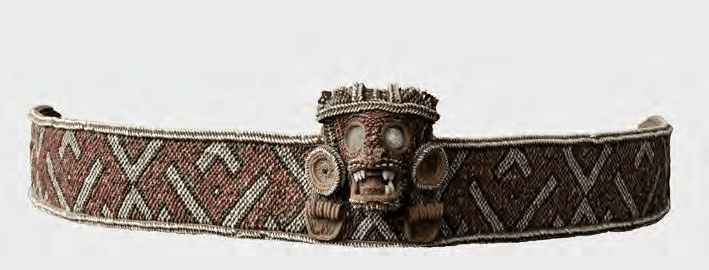
Eugenio Fernandez Mendez's Art and Mythology of the Taino Indians of the Greater West Indies is a frustrating read. A short work based on Taino art, mythology and archaeology seen in several examples of Taino art and glimpses from the Spanish chronicles, the author posits a significant Mesoamerican and/or Central American influence on the Taino. The actual chronology of this influence is uncertain, but the author is convinced of various mythological, theogonic and aesthetic similarities between the Taino and Mesoamerica, which presumably can be traced all the way back to the Olmec or proto-Olmec culture. How exactly this influence reached the Greater Antilles, and mainly Puerto Rico and Hispaniola, is unclear. If the general chronology of the rise of chiefdoms with greater political centralization and social differentiation began around 1000-1200 CE for Hispaniola and Puerto Rico, this is long after the Olmec and Classic Maya. However, if Mesoamerican influences may have sprung from an earlier period in the history of the circum-Caribbean, perhaps one in which peoples from the Yucatan, southern Mexico and other areas migrated to or traded with peoples living in the Greater Antilles, perhaps some stylistic and religious practices were transferred to the Taino. And who knows, perhaps the Totonac stone yokes are related to the famous stone collars of pre-Hispanic Puerto Rico.
There likely were contacts of some sort between the Antilles and Central America and Mesoamerica. Fernandez Mendez cites a number of sources indicating Taino contacts with Florida, northern South America, and Central America in the late 15th and early 16th centuries. These contacts likely existed long before Europeans arrived in the region. That said, there is a huge hole in Fernandez Mendez's theory. If Mesoamerican influences were so important on Taino mythology and art, why is so little evidence of this found in Jamaica and Cuba? We know indigenous people of Jamaica and Cuba likely had some degree of contact with the Yucatan, for example, but why is so little evidence of the influence of Mesoamerican "high" cultures evident on those islands? Why is it that more distant Hispaniola and Puerto Rico, where the most elaborate ballcourts, plazas, stone sculpture, duhos, and cacicazgos were developed, lack any incontrovertible evidence of trade or exchange with Mesoamerica? Did seafarers, traders, priests, and skilled laborers from Mesoamerica or Central America decide to skip most of Cuba and Jamaica because they were backwaters, demographically or culturally? It seems rather more likely that ideas or ritual practices may have reached Puerto Rico and Hispaniola via South America rather than a direct link to Mesoamerica. Fernandez Mendez seems to think otherwise, especially given the lack of elaborate ballcourts in northern South America.
However, the rest of his argument relies on speculative interpretations of Las Casas, Pane, Oviedo, and other chroniclers and the Spanish sources on Mesoamerican religion and ritual to claim a strong influence of the Maya, Huastecs and others on the Taino. While there definitely are parallels between the religious and mythological world of the Taino and, perhaps, the Aztecs and Maya, one can also find even more numerous direct parallels and ethnolinguistic evidence linking the Taino to the cultures of northern South America. Interpretations of Pane such as those of Arrom and Stevens-Arroyo are more convincing, particularly in that they are better supplied by ethnographic evidence on the indigenous peoples of the Orinoco Basin as well as linguistic, archaeological, and genetic evidence pointing to South America as a primary source of Taino civilization. Of course, this does not mean that there was no influence from Central America and Mexico. Human sacrifice and the religious symbolism of the Taino batey very well could have some degree of Mesoamerican influence which is not evident in the cultures of South America where similar ballgames were played. Unfortunately, Fernandez Mendez's speculative reading of Yocahu and Guabancex in relation to the pantheon of Mesoamerican belief relies too heavily on assumptions on identifying Taino cemis and artifacts with particular gods and attributes which are not verifiable. He proposes a number of interesting hypotheses and notes certain recurring motifs among indigenous peoples in the circum-Caribbean region. Yet some of these similarities are likely archetypes common across many cultures, especially the role of fertility, sun cults, the importance of wind and rain, and divine twins or gods with multiple attributes. He also relies on possibly outdated theories of the hurricane as a deity or deified force.
Whether or not a cultural stream from Mexico reached the Greater Antilles in the 14th century, also spreading to the southeastern US and other areas, actually transpired remains to be proven. Based on Fernandez Mendez's analysis, more work must be done to ascertain the nature of contacts between the Taino and their mainland neighbors to the west. Whether or not the common "fire god" of the Taino and various cultures in Central America can be proven by alleged stylistic conventions shared across time and space raises even more questions that we do not possess sufficient evidence to support. Similarly, do we truly possess enough evidence to claim the behiques of the Taino were ritualists associated with the Moon, the mother goddess and the serpent? Intriguingly, Fernandez Mendez does claim that the jibaros of Puerto Rico retained some interesting traces of their Taino ancestors and predecessors. For instance, the word soco, allegedly the central post in a caney of the Tainos, survived in Puerto Rican Spanish with the same meaning (and sexual connotations).
.png)