
Exploring the history of the cacicazgo of
Maguana is exceedingly difficult. Since we only know of Caonabo, its leader at
the time of Columbus's arrival in Hispaniola, speculation and the use of the
meager details of his life are the best clues. In addition, the topography of
the island, Maguana's relations with other cacicazgos and the traditions of
Indian misterios which have survived in the region of San Juan
de la Maguana are the other types of evidence one must consult. Besides these,
the brief references in the Spanish chronicles and some of the encomienda
system's records are most of what one can work with. We shall begin with the
chronicles and Columbus, then shift to other types of sources to reconstruct a
plausible theory for Maguana. Then, with a review of 20th century scholarship
and more contemporary studies, we shall endeavor to understand the features of the
Maguana chiefdom. It will be shown that Caonabo's political career and function
as a stranger king made him well-poised to understand the threat posed by the
Spanish to the balance of power. In truth, as a stranger who was able to
achieve great political power and status, Caonabo understood better than anyone
else why the Spanish were such a threat.
Non-Spanish Early Sources
First, the non-Spanish chronicles and
histories. Moreau de Saint-Mery wrote that Maguana was bordered to its south by
the sea, on its north by the mountain chains, on its east by the Jayna (Haina)
River, and on its west by the mountains of Bahoruco.[1] For Charlevoix, the Jesuit
historian, Maguana included the Cibao and its leader, Caonabo, was the most
powerful monarch on the island. Supposedly, Maguana was able to, with the aid
of its allies no doubt, muster 100,000 warriors led by Manicatex, a brother of
Caonabo.[2] Cuneo, a much earlier
source, attributed the total forces Caonabo capable of mustering to be 50,000,
so one presumes Manicatoex was receiving reinforcements from a broader alliance.[3] Nau, the 19th century
Haitian historian of the island's indigenous peoples, repeated the narrative of
Caonabo's Carib origin. One of Maguana's provinces included Niti, too.[4] Unsurprisingly, Nau likely
drew on the same sources as the earlier Francophone chronicles and texts.
An anonymous Frenchman, who presumably
drew on oral tradition, also wrote about Caonabo. In his case, the treasure of
Caonabo was thrown in the river by a wife after she heard the god of the
Spanish was gold. This lost treasure apparently consisted of 300 plaques of
gold, 52 charges of gold, a throne (presumably a duho) and a gold
table. Locals even reported that the treasure of Caonabo was still somewhere in
this river.[5]
However, the region around San Juan de la Maguana was perceived by some
non-Spanish writers as a part of the island in which people with mixed-race
Indian ancestry could be found.[6] So even into the 17th
century, the area around San Juan de la Maguana had a partly recognizable
indigenous heritage. Indeed, even Thomas Madiou reproduced a discourse by a
commandant of San Juan de la Maguana from the 1820s which reiterated the notion
of indigenous ancestry.[7] Last, but certainly not
least, Robert Schomburgk visited the site of the Corral de los Indios, a
ceremonial center that is often said to be the largest plaza in the Caribbean.
Although Schomburgk referred to it as a "Cercado de los Indios," it
is obvious he was referring to the same Corral.[8] Its tremendous size and
the use of a rock with evidence for eyes and a mouth near the center of the
plaza must have held some kind of cosmological or ritual significance. Despite
their limitations, these pre-20th century French and English sources do give a
sense in which indigenous traditions may have survived in the region of San
Juan de la Maguana. Naturally, this could very well be part of the legacy of
Maguana and provide possible clues to the region. Thus, the association of
water with indigenous spirits in the region today could very well be an example
of indigenous retentions.[9]
Spanish-Language Early Sources
Moving on to Spanish sources, the language
of all the primary sources, scholars have additional details and more questions
emerge. First, Columbus and others who visited Hispaniola in the 1490s provide
the earliest written sources to mention Caonabo or areas allegedly part of his
domains. For example, Columbus, who met Caonabo, referred to him as "a man
advanced in years and of great knowledge and very keen understanding.”[10] This suggests that
Caonabo was perhaps middle-aged or older by this time. He was not young or
politically inexperienced, as Guacanagari of Marien may have been. In fact,
Columbus's journal on the First Voyage likely alludes to parts of Caonabo's
territory when referring to places east of Marien: Guarionex, Macorix, Mayonic,
Fuma, Cibao, and Coroay.[11] It is highly likely that
the Cibao was part of Caonabo's territory, and Mayonic could have been
Columbus's garbled rendering of Maguana. In his other writings, Columbus
similarly described interactions with Caonabo and the land of Maguana. For
instance, he knew of "Cahonaboa" as "el cual posee tierra en que
ay mucho oro.”[12]
Elsewhere, in a memorial from 1494,
Columbus referred to Caonabo as "que es ombre, según la relación de todos,
muy malo e muy más atrevido.”[13] Clearly written during
the period of conflict with the powerful native ruler, Columbus acknowledged
the bold daring of Caonabo. This is why Columbus urged the sending of European
gifts to Caonabo to help lower his guard. The giving of gifts was quickly
understood by Columbus to be important in establishing close ties with the
indigenous elite of the island. But on Maguana specifically, Columbus's
writings report "y este Cahonabo dizen que en la tierra donde vive ay
mucho oro mas es tierra muy montañosa."[14] Upon consideration of
Caonabo's name, translated as "Lord of the Golden House" by Martyr
d'Anghiera, the cacique's territory must have included gold-producing parts of
the island. When he visited Maguana itself in 1495, Columbus noted the land's
proximity to the sierras and its acequias or irrigation
ditches, "como en Granada," to exploit the plentiful sources of water.[15] This reference to the use
of irrigation canals or ditches is especially significant. Since the use of the
same method of irrigation was used in Xaragua, whose leader at the time was a
brother-in-law of Caonabo, one is tempted to consider a technological transfer
from Xaragua to Maguana. Alternatively, both regions may have begun using
irrigation systems much earlier. Regardless of the origin of this practice, it
would have greatly increased the agricultural potential and provided higher population
densities. This could explain the large number of houses in Maguana's central
settlement, which Lynne Guitar claimed exceeded 1000.[16]
In addition to Columbus, a plethora of
other Spanish sources and chroniclers of the first half of the 16th century
mentioned Caonabo and Maguana. For instance, Martyr d'Anghiera's De
Orbe Novo gave a translation of Caonabo's name. Furthermore, based on
Morales's map of Hispaniola and other sources, d'Anghiera located Maguana in
Bainoa. Maguana itself was a valley through which the Bahaun River flowed.
Caonabo's siege of Alonso de Ojeda in the Fort of Saint Thomas was also
mentioned, including the bewildering tale of Caonabo's capture and imprisonment
by Ojeda. Like Columbus, d'Anghiera also stressed that Caonabo ruled
"Cipangu" (a misunderstanding on the part of Columbus for the Cibao,
mistakenly identifying it with Japan). But with a much smaller estimate of
warriors, Caonabo's brother was only able to gather 5000 men but they were
defeated by the Spanish (with the brother's capture, too).[17] Ferdinand Columbus, the
son of the Admiral, also referred to Caonabo in his biography of his father. In
this case, it was to the enmity between Caonabo and Guacanagari as the former
had stolen the wife of the other.[18] Although Columbus's son
offered a different narrative of Caonabo's capture, the general picture is
consistent with the other sources on Caonabo's destruction of La Navidad and
conflict with the Spanish. Las Casas, on the other hand, provided a richer description
of Maguana. For this author, Maguana was located near the Cibao and consisted
of valleys, rivers, plains, and sierras. It was fertile, enjoyed a moderate
temperature, and the Yaqui river passed through its territory. Maguana's name
referred to the fact that it was a smaller vega than Maguá,
the cacicazgo held by the family of Guarionex.[19] Las Casas even gives some
dimensions for Maguana, cited by Sued-Badillo as being 30 leagues long and 25
leagues wide.[20]
The other 16th century sources include
Oviedo's Historia general y natural de las Indias and the
records associated with the 1514 Repartimiento. Oviedo, who came to the island
long after the demise of Caonabo, believed the cacique was of Carib origin.
Moreover, he also saw the Ciguayos as subjects of Caonabo.[21] This seems unlikely if
the Ciguayos were based in Samaná, closer to the territory of Guarionex.
The 16th century records on the encomiendas of San Juan de la Maguana and other
towns in c. 1514 also allude to some details on Maguana. Of the 1,435 Indians
assigned to encomenderos there, some were the western part of the island. For
example, a cacique named Baltasar de Higuamuco likely came from the territory
Las Casas described as east of Guahaba. Others who likely came from the
cacicazgo of Maguana in precolonial times were assigned to encomenderos in
other towns. Thus, Hernando del Maguanabo, perhaps his name referring to
"House of Maguana," was assigned to Diego de Ocampo in Bonao.[22] Although his following
only consisted of 45 people, his name is highly suggestive of someone who may
have hailed from the precolonial Maguana elite. Other familiar names among the
indigenous leadership include Enrique, who later led a long-lasting revolt
against Spanish authority from the Bahoruco Mountains. As the nephew of
Anacaona, the wife of Caonabo, his presence in the Bahoruco area and San Juan
de la Maguana must have held some appeal to indigenous people who remembered
Caonabo for his fierce resistance to the Spanish.
Another cacique who may have been tied to
Maguana was Manicaotex, assigned to an encomendero in La Concepción
with 79 indigenous people in his community.[23] There is no evidence this
is the same person as the brother of Caonabo with the same name, but a
connection is possible. In fact, the name is reminiscent of the Taino
word manicato, perhaps signifying a bold leader. Another
cacique who may have been originally from the area of San Juan de la Maguana
(or Azua, likely part of the larger cacicazgo of Maguana) was Alonso de Ojeda.
Though assigned to an encomendero in La Buenaventura, the Hieronymite
Interrogatory of 1517 specifically named him as one of the caciques who
conspired to flee and resist Spanish attempts at forced relocations.[24] With 135 indigenous
people under his leadership, he may have been one of the more important
caciques in the Maguana or Azua area.[25]
Lingering Questions and Modern
Sources
After reviewing the French and Spanish
(and one English article) sources on Maguana before the 20th century, there are
many questions which remain. Was Maguana's dimensions as given by Las Casas
accurate? Was Caonabo a Lucayo or Carib? To what extent were the people in the
Bahoruco and areas near the modern Haitian border part of his domains? And was
his marriage with Anacaona a later development in his life after he
consolidated his power at the head of Maguana? Undoubtedly, the marriage
alliance with Anacaona strengthened his political position among the matunheri
caciques of the island. One wonders if Caonabo's political rise, despite his
foreign origins, was tied to a guatiao or fictive kinship link with the
previous lineage of Maguana. Or, was Caonabo a Lucayo or
"Carib" related to the ruling dynasty of Maguana? The question of
Caonabo's 3 or 4 brothers and the apparent succession of the throne to a
brother might be an indication of maternal lineage rooted in the region.
Perhaps Caonabo's branch was able to seize power through the effective military
leadership of Caonabo. Furthermore, one wonders if the Uxmatex, a cacique and
captain of Caonabo, was another one of his brothers.
Moving into the 20th century, several
secondary sources shed further light on Maguana with the aid of ethnohistory
and newer approaches to the archive. The 20th century Dominican
historian, Casimiro Moya, speculated that the territory of Maguana encompassed
the Cibao, Maniey, Azua and Banique.[26] Sven Loven, author of a
masterpiece on the indigenous Caribbean, seemed to prefer Caonabo as a Lucayo
whose success in wars preceded his ascent to the position of cacique of
Maguana. He also believed that the Corral de los Indios was a sanctuary site. The
crown of Caonabo was also described as having wings and gold-encrusted eyes.[27] Samuel Wilson, based on
Las Casas, recounted how Caonabo was captured and the brass bell of La Isabela
that could talk.[28]
Intriguingly, the fact that it took 18 months before Behechio of Xaragua tried
to annex parts of Maguana after the fall of Caonabo was also important, perhaps
showing how the defeat of Caonabo and his brother destroyed the paramount
chiefdom's stability.[29] E.W. Stone likewise
proposes the sacred spaces held by Maguana included El Cacique de Charco de los
Indios, Río Chacuey, Cueva Pomier, and Pico Duarte would have enhanced the
status of Caonabo.[30]
Besides these 20th century sources, several
additional scholars have analyzed aspects of Caonabo's life or the Maguana
cacicazgo. Valmé, drawing on a perhaps erroneous
method, estimated the Corral de los Indios site's batey, of 37,994 square
meters, could have held 11,400 people. Moreover, Maguana contained more than 45
drainage basins, another sign of the area's agricultural potential and
attraction to people.[31] Bernardo Vega, who drew
heavily upon the map of Morales and other sources, problematically asserted a
Ciguayo origin for Caonabo but failed to provide evidence.[32] Cassá,
however, theorized that Caonabo wanted to use Christian cemí power in his war
against the Spanish, which could be why Caonabo was willing to accept European
gifts.[33] Deagan, in her study of
En Bas Saline, the probable site of Guacanagari's capital, has also cited
sources on Columbus enslaving 600 of Caonabo's subjects in 1494/5.[34]
Significantly, Jean Fouchard, the Haitian
historian, also proposed that a Haitian "Chant de guerre de Caonabo"
from the 19th century is an authentic specimen of indigenous literature. First
published in La Selve's study of Haitian literature, the song is full of
Kalinago words like boutou. There's also a proposal that Caonabo
was from Guadeloupe, which is interesting since the indigenes of Guadeloupe
were in contact with Puerto Rico.[35] It is not implausible for
an adventuresome Kalinago from Guadeloupe or the Lesser Antilles to have
reached Hispaniola, too. But the chant's fusion of mostly Kalinago words with a
few examples of Taino words seems more typical of a 19th century Haitian literary
style, which sometimes conflated Kalinago and Taino cultures. Thus, the song is
full of words like Kouroumon and Bayakou. The song also refers to Guacanagari
as a traitor, which does match how chroniclers described the animosity between
Guacanagari and other caciques of Hispaniola.[36] Since the song's origins
are unclear and it is unlikely to be an authentic war song from 1492 or 1493,
it is perhaps better seen as an example of how 19th century Haitian authors
imagined the areyto. Nonetheless, the claim of an origin in
Guadeloupe for Caonabo is not outside the realm of plausibility and has at
least some basis in the Spanish chronicles.
The most important sources on Caonabo,
however, are the works of Keegan and Ostapkowicz. The former, author of a study
on Caonabo as a stranger king, draws extensively on his own archaeological
research in the Lucayan islands. Keegan has also tied the notion of Caonabo as
"Carib" to a Taino mythical geography. Moreover, the references in
the sources to Caonabo and his 3 brothers are reminiscent of Deminan and his 3
brothers in Taino myth).[37] If Caonabo was a wise,
stranger figure whose life could parallel important figures in Taino mythology,
this model may elucidate how he was able to ascend to the status of most
powerful cacique on the island. Keegan even suggests that he could have been the
guardian of the mythical cave of origin, Cacibajagua, if it was included in his
domains.[38]
Of course, we have argued against the location of Cacibajagua in the domains of
Caonabo,[39]
but the central location of Guacanagari and the gigantic plaza at El Corral de
los Indios likely has cosmological significance that went beyond the confines
of Maguana. In terms of archaeology, Keegan has identified a possible site for
an important village Caonabo may have come from: the MC-6 settlement
established no earlier than 1300.[40] If Caonabo was indeed a
Lucayan, as indicated by Las Casas, he could have come from this important, cosmologically
charged site that was linked to Hispaniola. Indeed, Maguana may have
represented the center of the island and the center of the world from the
perspective of the indigenous peoples, a notion also shared by Valmé.
Ostapkowicz, on the other hand, brings a
keen attention to detail and textual sources with a study of Taino material
culture. In her thesis, a study of the Taino duho, Columbus is
cited for Caonabo's explanation that every principal cacique of the island
believed that after death, people go to a valley where they see their
ancestors, eat, access their wives, and more. Caonabo explained that every
cacique believed the valley of the afterlife was located somewhere in their own
territory, perhaps implying that Coabay was not located in a single place.[41] In her recent study of
cloth and fibrous materials, Ostapkowicz delves into an analysis of various
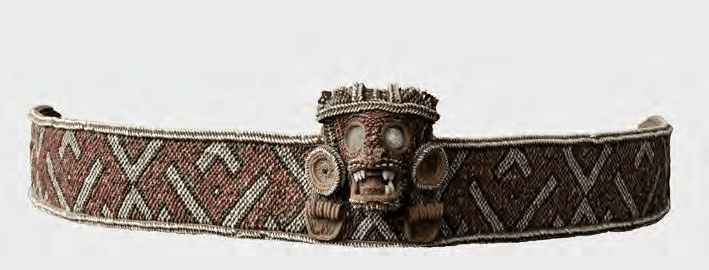
items received in tribute from Caonabo's community in 1495. A combination of
belts, masks with gold parts, naguas, hammocks, cotton, and sheets of gold were
collected from Caonabo's Indians.[42] The presence of much
material using cloth, though not as much as the cloth and textiles found in
Anacaona's storehouse, indicates the degree to which cotton and textiles were
part of the wealth of a cacique. As one of the most powerful caciques, and one
whose name referred to gold, it is striking how so much of the tribute
collected from Caonabo's subjects consisted of cloth. While gold was used with
the masks and other objects given to the Spanish, one can detect a similar
sense of value and wealth in Caonabo's Maguana as that of Xaragua. Given the
close ties between Xaragua and Maguana, as well as the use of irrigation canals
in both chiefdoms, perhaps cotton was one of the additional sources of wealth
for Maguana. Alternatively, cotton may have been given in gift exchanges
between Xaragua and Maguana, with the latter possibly serving as a source of
gold.
Conclusion
In summation, the mystery of Caonabo
remains. For about 500 years, writers have disagreed on his origin. Keegan's
theory of a possible origin in Middle Caicos is intriguing, but of course only
a speculation. The "Carib" origin theory could still be true, but
academics should explore the links between Hispaniola and the Lesser Antilles.
For instance, the finding of Hispaniola-styled duhos at sites
in the Lesser Antilles may be evidence of elite exchange or trade, perhaps
pointing to a possible Kalinago origin of Caonabo through one of these
networks. Moreover, questions remain on the domain of Maguana and how the
chiefdom may have looked before 1492. In terms of the chiefdom's
characteristics, the existence of irrigation canals or ditches as well as
control of gold-producing areas likely made Maguana a populous center of
attraction for much of Hispaniola. The alliance with Xaragua, another densely
populated region with ample cotton production, likely included military
dimensions that may have made Caonabo one of, if not the most, powerful
caciques in Hispaniola. Finally, Caonabo's foreign origins and deft navigation
of the political landscape of the island made him the best positioned to
understand the threat posed by the Spanish.
[1] M.L.E. Moreau de Saint-Méry, A
topographical and political description of the Spanish part of Saint-Domingo:
containing, general observations on the climate, population, and productions;
on the character and manners of the inhabitants; with an account of the several
branches of the government, Volume 1, 34.
[2] Pierre-François-Xavier de
Charlevoix, Histoire de l'Isle espagnole ou de S. Domingue, Vol. 1,
81-82, 172.
[3] Carl Ortwin Sauer, The Early Spanish
Main, 84.
[4] Émile Nau, Histoire
des caciques d'Haïti, 116-117.
[5] Cultivateur de la Haute-Saône, Observations
météorologiques et physiques sur St.-Domingue. Description du Rio-del-Oro, ou
Rivière d'Or de Christophe Colomb. Découverte des mines d'or par cet amiral.
Renseignemens sur les trésors du cacique Caonabo. Origine des peuples
d'Amérique. Description de leur berceau. Ages des deux mondes. Numéro 6 /,
32-33.
[6] Alexander O. Exquemelin, The
Buccaneers of America, 36.
[7] Thomas Madiou, Histoire d’Haiti,
Tome VI, 356.
[8] Robert Schomburgk, “Ethnological Researches in Santo
Domingo,” 91-92.
[9] Martha Ellen Davis, La otra
ciencia: el vodu dominicano el vodú dominicano como religión y medicina
populares, 138.
[10] Christopher Columbus in Ramón Pané,
An
Account of the Antiquities of the Indians, 45.
[11] Christopher Columbus, The
Journal of Christopher Columbus (During His First Voyage), 141.
[12] Cristóbal Colón, Textos y
documentos completos: Relaciones de viajes, cartas y memoriales, 243.
[13] Ibid., 256.
[14] Ibid., 277.
[15] Ibid., 324.
[16] Lynne Guitar, Cultural Genesis:
Relationships among Indians, Africans, and Spaniards in rural. Hispaniola,
first half of the sixteenth century, 121.
[17] Peter Martyr d’Anghiera, De
Orbe Novo.
[18] Ferdinand Columbus, The Life of the
Admiral Christopher Columbus by His Son, 148.
[19] Bartolomé de Las Casas, Apologética
historia sumaria.
[20] Jalil Sued-Badillo, Caribe
taíno: Ensayos históricos sobre el siglo XVI, 19.
[21]
Gonzalo Fernandez de Oviedo, Historia
general y natural de las Indias, primera parte Vol. 1, 67.
[22] Luis
Arranz Márquez, Repartimientos y encomiendas en la Isla Española (El
repartimiento de Alburquerque de 1514), 569.
[23] Ibid., 584.
[24] Behique Dunama, “Interrogatorio
de los Jeronimos.”
[25] Luis Arranz Márquez, Repartimientos
y encomiendas en la Isla Española (El repartimiento de Alburquerque de 1514),
567.
[26] Casimiro Moya, Bosquejo
histórico del descubrimiento y conquista de la isla de Santo Domingo y
narración de los principales sucesos ocurridos en la parte española de ella
desde la sumisión de su último cacique hasta nuestros días: Epoca de la
conquista y gobierno de los españoles hasta la sumisión de los últimos indios.
Libro primero, Volume 1, 23.
[27] Sven Loven, Origins
of the Tainan Culture, West Indies, 97, 509.
[28] Samuel Wilson, Hispaniola: Caribbean
Chiefdoms in the Age of Columbus, 86.
[29] Ibid., 91.
[30] E.W. Stone, “The Conquest of
Española as a “Structure of Conjuncture,”’ 371.
[31] Gilbert R. Valmé, Atabey,
Yucayequey, Caney : 6000 ans d'amenagement territorial prehispanique sur l'ile
d'Ayiti / Haiti/ Republique Dominicaine, 15, 181.
[32] Bernardo Vega, Los Cacicazgos
de la Hispaniola, 57.
[33] Roberto Cassá, Los
Tainos de la Española, 222.
[34] Kathleen Deagan, En Bas Saline:
A Taíno Town Before and After Columbus, 34.
[35] Jean Fouchard, Langue et
littérature des aborigènes d'Ayti, 91.
[36] Ibid., 92.
[37] William F. Keegan, Taíno Indian
Myth and Practice: The Arrival of the Stranger King, 35, 45.
[38] Ibid., 46-47.
[39] Behique Dunama, “Caonao
(Cahonao).”
[40] William F. Keegan, Taíno Indian
Myth and Practice: The Arrival of the Stranger King, 182.
[41] Joanna Ostapkowicz, Taino
wooden sculpture: rulership and the visual arts in the 12–16th century Caribbean,
518.
[42] Joanna Ostapkowicz, Anacaona’s Gift: Cotton
and the woven arts of the 11th to 17th century Caribbean, 187-189.
No comments:
Post a Comment